
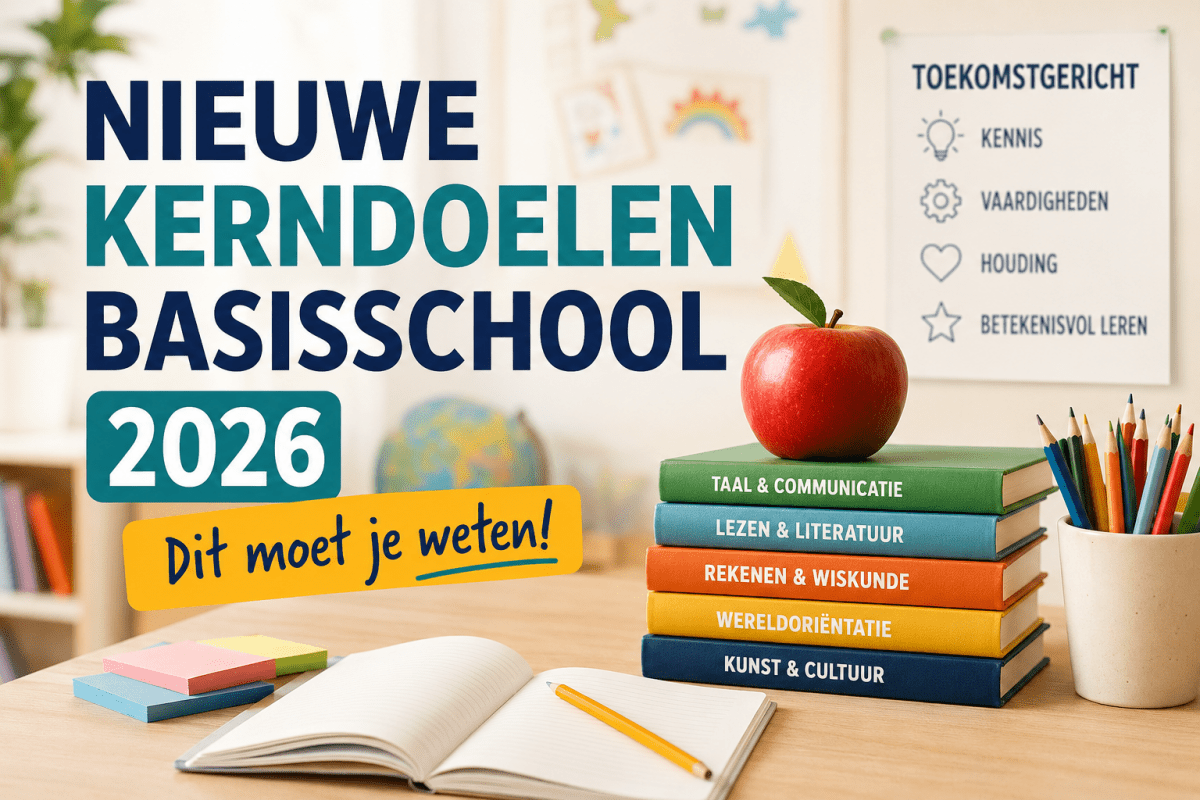
Primary education in the Netherlands is innovating with the introduction of the revised national curriculum from the SLO foundation. The new primary school core objectives offer schools a clear basis. This enables them to further strengthen children's reading and language skills.
Within the Dutch language learning area, the emphasis is increasingly on rich texts, reading motivation, and a coherent approach to language. But what exactly do these new core objectives mean? And as a parent, how can you align what your child learns at school with activities at home?
What are SLO's new primary school core objectives?
Core objectives are legally established mandates. They describe what students in primary education must learn and experience. With the new primary school core objectives, teachers receive a strong foundation. This accounts for approximately 70% of teaching time.
Schools can further shape their education with these objectives. This includes offering, mastery, and experiential goals. Moreover, the core objectives must contribute to equal opportunities. In this way, children are prepared for a meaningful place in society.
The three domains for Dutch: Communication, Language, and Literature
Within the revised Dutch language learning area, knowledge, skills, and attitudes are closely intertwined. SLO therefore distinguishes three main domains:
- Communication (Core Objectives 2 to 5): This domain focuses on listening and reading with (deep) comprehension. Additionally, children learn to produce purposeful texts and conduct constructive conversations.
- Language (Core Objectives 6 & 7): Students gain insight into the language system. This includes, for example, spelling, grammar, and punctuation. They also discover how language is related to identity and language variation.
- Literature (Core Objectives 8 & 9): Experiences with narrative texts are central here. Additionally, children discover their own reading preferences. They also learn to appreciate the value of literature.
How do the new core objectives change reading education?
The revised core objectives place more emphasis on coherence. Language activities are therefore less often offered in isolation. Reading, writing, speaking, and listening can now be connected to each other.
The following components, among others, are important:
- Rich language and reading environment (Core Objective 1A): Schools provide meaningful contexts. Additionally, children receive a diverse and current offering of youth literature. A regular reading routine plays an important role in this.
- Language development in all subjects (Core Objective 1B): Rich texts are not only used during Dutch language lessons. Children can also work with different types of texts in social studies, arithmetic, and other subjects. This makes language an increasingly integral part of overall education.
- Comprehension and reliability (Core Objective 2A & 2C): Students learn to distinguish main and secondary ideas. Additionally, they learn to use strategies to better understand texts. Children also learn to assess sources for reliability and recognize misleading information.
Connecting with the new core objectives for reading at home
The foundation for literacy is laid at school. However, a lot of reading is done at home. Therefore, as a parent, you can also play an important role.
By providing varied and inspiring reading material at home, you align well with the new core objectives. Moreover, regular reading can help stimulate reading pleasure and motivation.
1. Ensure a continuous supply of varied books
According to core objective 8A, developing one's own reading preference is important. Children therefore get acquainted with different authors and literary genres. A varied book offering helps with this.
With our Children's Book Subscription (Quarterly Reading Box), you bring new books into your home every season. The books are tailored to your child's reading level and world of experience. This ensures the offering remains innovative.
- Quarterly Subscription (€39.95 per quarter): This is the most affordable option. You save €10 per box. Every quarter, your child receives a carefully curated, customized box. Moreover, the subscription is flexible. You can easily pause or cancel per edition.
- One-time Box (€49.95): Prefer not to have a subscription? Then a one-time box is a good choice. You can use it as a trial box or a gift, for example.
2. Targeted support for basic skills
Does your child struggle with technical or reading comprehension? Or do you want to support school material at home in a structured way? Then extra practice moments can help.
The Reading and Arithmetic Packages from Kinderboekenland provide a practical addition to education. The packages align with important basic skills. Children practice language, spelling, and arithmetic in a playful way. This allows them to gradually gain more confidence in their own abilities.

Frequently asked questions about the new core objectives
When will the new primary school core objectives come into effect?
The draft core objectives have been established by SLO. They will then be anchored in legislation and regulations. After that, schools will start working with them according to the new national agreements.
Why have the core objectives for Dutch been revised?
The core objectives have been revised to create more coherence within language education. This connects technical reading, reading comprehension, and spelling more closely. Additionally, there is more attention for reading enjoyment, reading motivation, and broad literacy in children.


